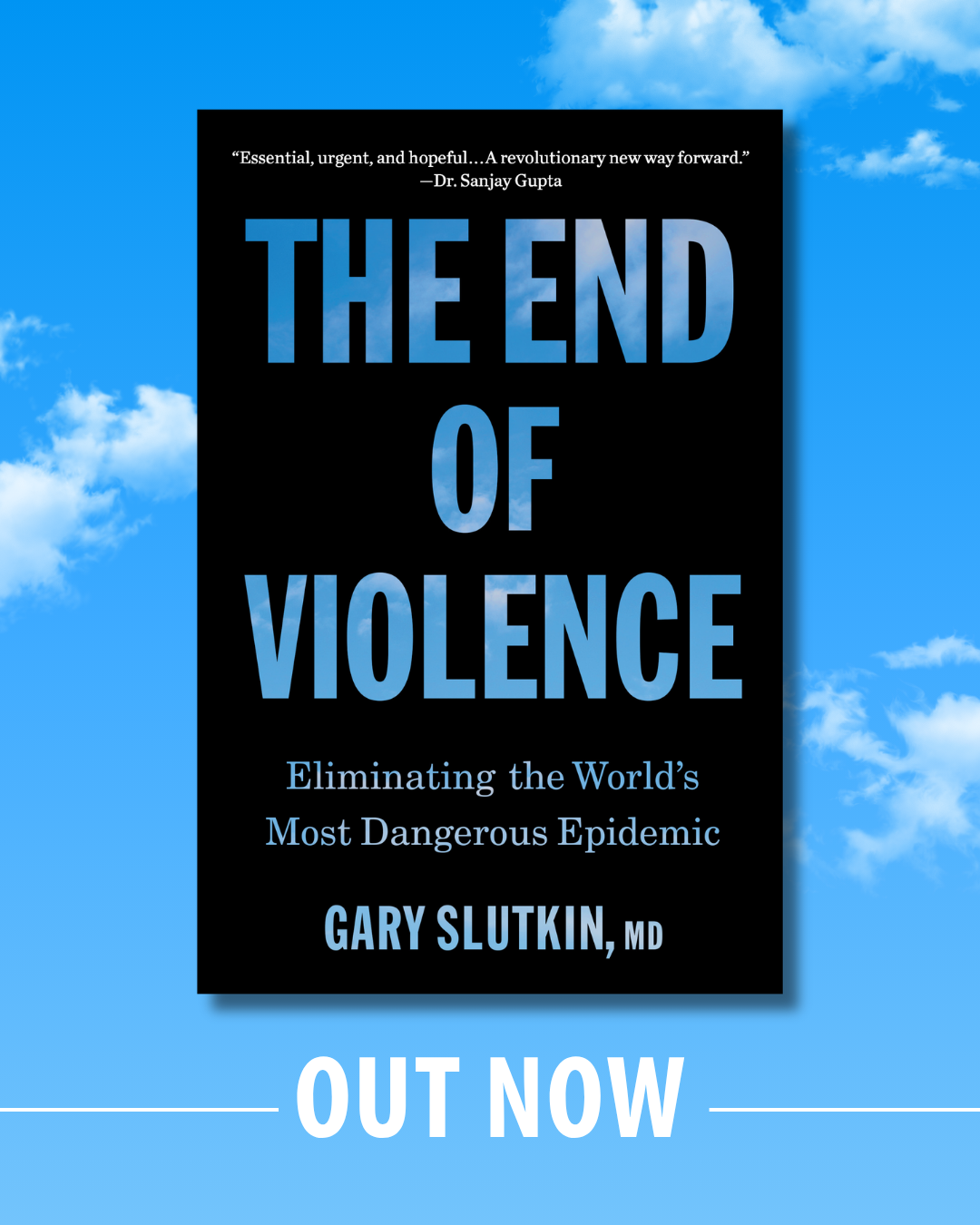
The End of Violence
A bold new approach for eliminating the world’s most dangerous epidemic—using the same epidemic control playbook that rid the world of other contagious diseases.
Violence is often regarded as an unavoidable fact of life. The truth is far more hopeful: violence is a disease that can be cured.
Here, epidemiologist and violence prevention specialist Dr. Gary Slutkin reclassifies violence as a a disease: one that enters the brain and infects people, communities, and countries via the same process as other epidemics. When shootings occur in a school or community, a political figure is assassinated, or an authoritarian leader directs violence in his nation’s own cities, these are not just tragedies, but disease outbreaks that must be interrupted and contained.
As an epidemiologist, Dr. Slutkin led teams to end epidemics of cholera and tuberculosis, then HIV/ AIDS in Africa and Asia with the World Health Organization. Returning to the US, he began to discover the invisible science of violence—and how to contain it using the very same epidemic control methods.
The End of Violence offers a time-tested roadmap for recovery: the playbook that has been used to dramatically reduce or eliminate violence in many of the most dangerous neighborhoods throughout the US and Latin America and has been successfully adapted to curtail political violence, election violence, and gender-based violence in countries around the world.
Domestic violence, mass shootings, state tyranny, and war are all syndromes of the exact same disease, all requiring the same interventions. We already have the tools to protect ourselves, heal our communities, and end violence in our lifetime.
It is now up to us to use them
Findings in This Book
Violence is a contagious and epidemic disease. There is no other way to see it now.
We often think about violence as an expected and usual feature of our world and something that will always be with us. That’s what we thought about plague and leprosy and typhus, and other diseases that devastated us - until we figured out how they really worked in our brains and bodies, and how they spread. Only then did we develop brand new strategies to stop the disease, as we now have for violence. This is true for all forms of violence – from bullying to family violence to war.
Violence is not primarily about morality. It is a disorder. We have found what is invisibly going on inside us.
We now know the scientific means and pathways in the brain and body that cause violence to spread – and how this works within us and between us. For far too long, we have thought of people who have contracted violence in strict moral terms, as we had for other diseases before we understood what was going on invisibly. We have a new way forward now with this new understanding They have simply contracted a disease working through three specific brain pathways on overdrive. What they need is care, not judgment. And timely prevention to interrupt spread.
We don’t need to cure all our social problems to stop violence. Stopping violence first gives the other problems the room to be solved.
Since violence seems so mixed up with other social problems—like poverty and poor education, we used to think we have to solve these problems to stop violence. But it works the other way around. Solving these other problems are not possible where violence persists. THE END OF VIOLENCE reveals that violence can be reduced and even ended amid these other challenges. And this gives these other problems the chance to come to life, revealing that curing violence is the first and critical step in improving the conditions for all of us. And we now know how to do it.
Violence is what causes violence. And this goes for all types - and even between the types from child abuse to family or community violence, mass shootings, war, tyranny and genocide.
The main predictor of violence is exposure to past and present violence. The likelihood of doing violence or having it done to you is the dose of exposure, and your proximity And whether you have certain brain susceptibilities like grievance or the need to belong that work through actual brain pain centers. Were you the victim of a violent act? Did you witness it? How close are you socially to the people involved? It is now possible to map violence via these factors, identifying people at highest risk and helping in specific ways to prevent future violence, including outbreaks.
A world without violence is not only doable, but in many communities, violence is already disappearing.
All violence – of any form - can be anticipated and prevented. And when we know how to do that violence can be stopped fast - and on its way to being eliminated - like for many other epidemic diseases. This health approach identifies hotspots, contains outbreaks, and changes our social norms and makes violence almost unheard of, and no longer a public health problem. Results of up to 70% drops, and in some cases up to 90%, have been shown in several communities in the U.S. and Latin America, in several cases to record lows, and even to zero for up to three years. We are seeing results now in our families, communities, even with gangs and cartels, in prisons, in election and political violence, and in conflict zones.